Common Causes of Low Water Pressure in Irrigation Systems in Arizona
Imagine walking out to your Surprise backyard on a July morning only to find your lawn dotted with brittle, brown patches despite your timers running on schedule. You check the zones and find your sprinkler heads barely bubbling over, failing to reach the landscape they're meant to protect. This frustrating sight is often the first sign that you need a low water pressure irrigation fix to save your turf before the desert heat causes permanent damage.
It's natural to feel a sense of anxiety when you see your plants wilting while your utility bill rises. You've likely invested significant time into your outdoor space, and a malfunctioning system feels like a threat to that hard work. We understand that in our specific climate, where up to 70% of residential water use happens outdoors, every drop must be delivered with precision to ensure the longevity of your property.
This guide provides a professional roadmap to help you identify and resolve the root causes of weak flow. We'll examine common culprits like clogged filters, failing valves, and hidden leaks with the methodical approach of a seasoned specialist. You'll learn how to restore your system's efficiency, lower your water costs, and gain full confidence in your irrigation's reliability for the seasons ahead.
Recognizing the Signs of Low Irrigation Pressure in Desert Landscapes
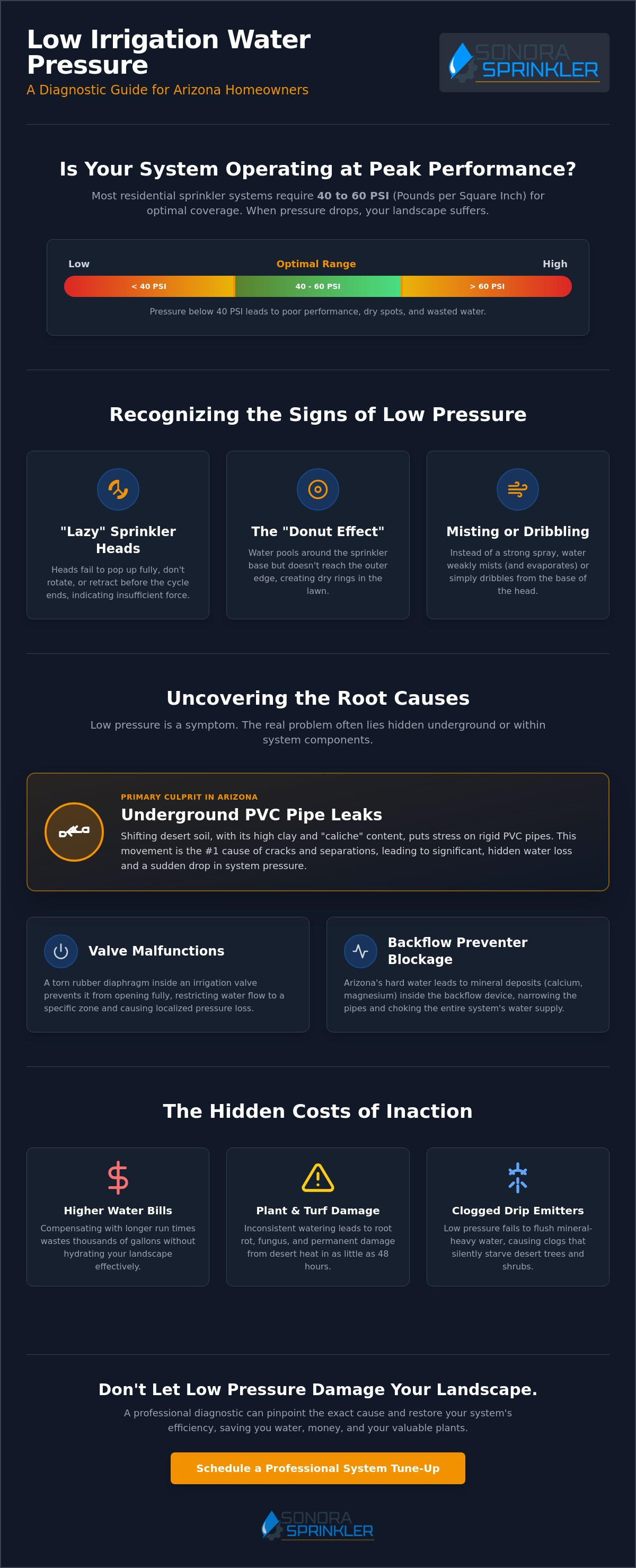
Identifying a drop in performance early is the most effective way to protect your investment in your landscape. For most residential systems in Arizona, water pressure is measured in pounds per square inch (PSI). Most standard sprinkler heads require a consistent range of 40 to 60 PSI to function as intended. When the pressure falls below this threshold, the mechanical components within the head cannot overcome the tension of the internal retraction springs. This results in "lazy" sprinkler heads that fail to pop up fully or lack the force needed to complete their rotation cycles.
Understanding how irrigation sprinklers work helps clarify why even a minor pressure drop causes significant coverage gaps. One of the most common symptoms we see is the "donut effect." This occurs when the water reaches the area immediately surrounding the sprinkler head but lacks the velocity to reach the perimeter of the zone. In cities like Surprise and Peoria, where summer temperatures frequently exceed 110 degrees, these coverage gaps are more than just an eyesore. Many local turf varieties can suffer permanent damage or die within 48 hours if they are deprived of deep, consistent watering. Recognizing these signs early allows you to implement a low water pressure irrigation fix before the desert heat necessitates a total lawn replacement.
Visual Cues of Weak Sprinkler Flow
You don't always need a pressure gauge to know your system is struggling. A quick visual inspection during a run cycle often reveals the following issues:
-
Base Dribbling: Instead of a crisp spray pattern, water bubbles or dribbles out at the base of the riser, creating localized puddles.
-
Weak Misting: The spray appears as a thin, sputtering mist or fog that easily drifts away in the afternoon wind rather than landing on the target vegetation.
-
Loss of Head-to-Head Coverage: You notice dry, straw-colored patches appearing exactly halfway between two sprinkler heads that previously provided overlapping coverage.
The Hidden Danger of Low Pressure
While visible dry spots are obvious, low pressure often causes secondary problems that are harder to detect. Many homeowners attempt to compensate for weak flow by increasing their controller's run times. This rarely solves the problem and typically leads to significantly higher water bills without actually hydrating the soil. Excessive water pooling near the head can lead to root rot or fungal issues, even as the rest of the zone remains bone-dry. Additionally, low pressure is particularly detrimental to drip irrigation systems. Without sufficient force to flush out the mineral-heavy water common in the West Valley, emitters can quickly clog with calcium deposits. This leads to the silent failure of your desert trees and shrubs, often going unnoticed until the plant is beyond saving.
Root Causes: Why Your Sprinkler System Lost Its Power
Identifying the root cause of a pressure drop requires looking beyond the sprinkler head itself. While a "lazy" pop-up is the symptom, the source of the problem usually lies within the mechanical components or the subterranean infrastructure. In the Arizona desert, the primary culprit is often an underground PVC pipe leak. Our local soil, characterized by high clay content and "caliche" layers, shifts significantly during extreme temperature swings and monsoon seasons. This movement places immense stress on rigid PVC joints, eventually causing them to crack or separate. Implementing a low water pressure irrigation fix requires a methodical look at how these underground components interact with the surface environment.
Mechanical Failures in Valves and Backflow Devices
The heart of your system's regulation resides in the valve manifold and backflow preventer. A torn diaphragm within an irrigation valve is a frequent cause of localized pressure loss. When this rubber component degrades, it fails to open fully or creates internal turbulence that restricts flow. Similarly, the backflow preventer, which protects your home's potable water, can become a bottleneck. Arizona's hard water is notorious for depositing minerals like calcium and magnesium inside these devices. Over time, this buildup narrows the internal ports, choking the water supply before it ever reaches the zones. You should also verify that the main shut-off valve at the water connection hasn't been accidentally bumped into a partially closed position.
Underground Issues and Pipe Fatigue
Subsurface problems often remain hidden until they manifest as a total zone failure. Tree roots are a persistent threat; as they expand, they can exert enough pressure to crush or kink PVC lines, effectively cutting off the water supply. We also frequently encounter issues where "poly" pipe transitions fail. These flexible lines are common in drip zones, but the connection points often struggle with the intense heat of our soil. Even a single pinhole leak in a lateral line can vent enough force to drop the operating pressure across an entire zone, preventing heads from popping up.
While most issues are internal, municipal fluctuations can play a role. During "peak time" neighborhood usage, such as early morning hours when everyone's timers are set, the city's main pressure may dip. If your system is already on the edge of its performance limit, this slight drop can be the tipping point. Finding the right low water pressure irrigation fix often starts with a professional irrigation diagnostic to pinpoint the exact failure point. According to the EPA on microirrigation systems, maintaining proper pressure is the single most important factor in preventing component failure and ensuring water efficiency in arid climates.
Step-by-Step Diagnostics: Finding the Fix for Low Pressure
Finding a reliable low water pressure irrigation fix begins with a logical process of elimination. Rather than digging up your yard at the first sign of a dry patch, we recommend starting at the primary water source. Verify that your main water shut-off valve is fully open. It's common for these valves to be partially closed during unrelated plumbing repairs, which silently chokes the supply to your entire property. If your home's indoor faucets also seem weak, the issue likely resides with the municipal supply or a failing pressure regulator on the main line rather than the sprinkler system itself.
Once you've confirmed the main supply is sufficient, move to the "end of the line" for a more granular check. Every irrigation run has a head located furthest from the valve, where pressure is naturally at its lowest point. Remove the nozzle from this head and run the zone for thirty seconds to flush out any trapped debris or mineral sediment. For a truly professional diagnostic, attach a pressure gauge to this furthest head. This provides a verified PSI reading, telling you exactly how much force is lost between the valve and the final emitter. For those managing more complex setups, this guide on Troubleshooting a Drip Irrigation System offers a structured approach to identifying hidden bottlenecks in low-flow lines.
System-Wide vs. Zone-Specific Troubleshooting
Determining the scope of the pressure loss is critical for a fast repair. If every zone in your landscape is underperforming, the problem is centralized. In these cases, focus your inspection on the backflow preventer or the main irrigation supply line. However, if the pressure drop is isolated to a single zone, the culprit is likely a localized issue. We suggest performing a methodical "walk-through" while the problematic zone is active. Look for unusually green patches of grass or "mushy" soil, as these are clear indicators of a lateral line break hidden beneath the surface. If you don't see surface water, the issue may be a failing solenoid or a restricted port within that specific valve manifold.
Quick DIY Fixes for Minor Pressure Issues
Not every pressure problem requires a major excavation. Many issues stem from simple maintenance oversights that you can address in a few minutes. Start by cleaning the small plastic filters located beneath each sprinkler nozzle, as these frequently clog with fine desert sand. Next, check the flow control handle on top of your zone valves; these knobs can be turned down accidentally, restricting the water volume. Finally, inspect your irrigation controller's settings. Many modern timers have a "seasonal adjust" or "water budget" feature. If this was accidentally lowered to 50% or 70%, your system won't provide the volume necessary to reach full operating pressure.
Long-Term Pressure Management for Surprise and Peoria Homeowners
Sustainable landscape health in the West Valley requires moving from reactive repairs to a proactive management strategy. Ensuring your system can withstand the intense summer heat starts with regular sprinkler system tune-ups to catch minor wear before it leads to a total zone failure. By identifying thinning pipe walls or aging valve diaphragms during the cooler months, you prevent the emergency of a dead lawn in July. A well-maintained system doesn't just save water; it preserves the structural integrity of your entire irrigation network.
One of the most effective ways to achieve a permanent low water pressure irrigation fix is by installing pressure-regulating spray heads (PRS). These components are designed to maintain a constant exit pressure, even if the main supply fluctuates. This prevents the "misting" or "fogging" that occurs when pressure is too high, while ensuring that heads at the end of a long run still receive enough force to pop up and rotate correctly. Stabilizing the hydraulics of your system reduces the physical stress on your PVC pipes, which significantly extends the lifespan of your underground infrastructure.
In many older Surprise neighborhoods, we find that original irrigation designs often over-tax a single zone by placing too many heads on a single line. As trees grow and water needs change, what once worked may no longer be sufficient. Managing this demand by splitting a struggling zone into two smaller, independent runs ensures that every head has the volume required for head-to-head coverage. Modern smart irrigation controllers further enhance this by providing real-time flow monitoring. These devices can detect abnormalities in water usage and alert you to a hidden leak or a pressure drop before your desert plants show signs of distress.
Upgrading Your System for Better Efficiency
Upgrading the core components of your system can provide a significant boost to overall flow and safety. We often recommend installing a dedicated master valve, which acts as a primary fail-safe for your property. If a zone valve fails to close or a pipe bursts, the master valve shuts off the water supply to the entire manifold, preventing catastrophic water loss. Additionally, replacing outdated brass valves with modern, serviceable PVC manifolds allows for easier maintenance and better flow characteristics. For properties with long residential runs, transitioning to a larger diameter PVC pipe can reduce friction loss, ensuring that the water reaches the furthest corners of your landscape with its full intended force.
Preventative Maintenance Checklist
Consistency is the foundation of a reliable irrigation system. We suggest a quarterly inspection of your backflow device to check for signs of rust or external weeping that could indicate internal restriction. Drip irrigation lines should be flushed annually to remove the fine silt and mineral sediment that accumulates in our local water supply. We recommend a professional system diagnostic at least once every twelve months to ensure your irrigation remains resilient against the harsh Arizona climate. If you are ready to modernize your outdoor water management, our team can help you select the right sprinkler upgrades for your specific property needs.
Professional Irrigation Repair: When to Call Sonora Sprinkler
While many common issues can be resolved with a basic cleaning or a simple adjustment, certain pressure failures require the precision of a professional specialist. When a low water pressure irrigation fix involves tracing a faulty underground wire or replacing a main PVC line buried deep beneath compacted desert soil, the complexity exceeds standard DIY capabilities. These scenarios demand specialized diagnostic equipment and a thorough understanding of hydraulic principles to ensure the repair is both effective and durable.
Choosing a licensed residential specialist provides the assurance that your system is being handled by an expert who understands local environmental nuances. At Sonora Sprinkler Inc., we prioritize the long-term health of your landscape by focusing on the specific challenges found in Surprise and Peoria. Our approach combines technical proficiency with a protective mindset, ensuring that every component from the backflow preventer to the final drip emitter operates at peak efficiency. We take pride in our role as a steady, dependable fixture in the community, offering the grounded expertise that only a family-owned business can provide.
The Expertise of Sonora Sprinkler Inc.
Our team excels in advanced diagnostics that go beyond surface-level symptoms. We utilize specialized tools for irrigation wiring and valve failure detection, allowing us to pinpoint electrical shorts or mechanical blockages without unnecessary excavation. Beyond simple repairs, we offer custom retrofitting for existing desert landscapes. This process involves evaluating your current layout and implementing a custom sprinkler system design that maximizes every drop of water, even in older systems that have historically struggled with weak flow. By focusing exclusively on residential service, we remain dedicated to the unique needs of Surprise homeowners, ensuring our solutions are perfectly scaled for domestic property management.
Schedule Your Pressure Diagnostic Today
Ignoring a drop in water pressure is a risk that often leads to escalating costs. A minor leak or a struggling valve can quickly manifest as a spike in your monthly utility bill or the loss of mature, expensive vegetation. It’s far more cost-effective to address these symptoms early with a professional evaluation. Trust the master craftsmen who have spent years navigating Arizona’s unique soil challenges and mechanical requirements. We are committed to providing the functional results and reliability your home deserves. Schedule your professional irrigation repair in Surprise AZ today and restore the efficiency and health of your desert landscape.
Secure the Longevity of Your Desert Landscape
Protecting your property from the intense Arizona heat starts with a high-performing sprinkler system. By recognizing the early signs of weak flow and following a logical diagnostic path, you can often identify issues before they lead to permanent turf loss. Whether the solution involves clearing a simple nozzle clog or implementing a comprehensive low water pressure irrigation fix for a failing valve manifold, taking action now ensures your landscape remains resilient through the hottest summer months.
When mechanical issues become complex, trust a team that understands the specific demands of our local environment. Since 1999, our family-owned and operated business has served the Surprise and Peoria communities with grounded expertise in desert-specific water management. We specialize in expert PVC pipe and valve diagnostics, providing the precision needed to restore your system to its optimal state. Restore your system’s power with Sonora Sprinkler’s expert repair services and enjoy the peace of mind that comes with a reliable, efficient irrigation system. Your landscape is a significant investment; we're here to help you protect it for years to come.
Frequently Asked Questions
Why do my sprinklers have low pressure but the house water is fine?
Irrigation systems often utilize a dedicated shut-off valve or a backflow preventer that can fail or become partially closed independently of the main house supply. This separation means you can have perfect pressure at your kitchen sink while your landscape struggles. Common culprits include a restricted irrigation master valve or mineral buildup specific to the outdoor lines that doesn't affect your indoor plumbing.
Can a broken sprinkler head cause low pressure in the rest of the zone?
A single broken head acts as an open wound in the system, venting high volumes of water and dropping the PSI for all other heads on that line. When water escapes too quickly through a cracked riser or missing nozzle, the remaining heads lack the force needed to pop up or rotate. Replacing the broken component is often the simplest low water pressure irrigation fix to restore zone-wide performance.
How much pressure (PSI) does a residential sprinkler system actually need?
Most residential systems in the West Valley require between 40 and 60 PSI to operate effectively and provide full coverage. If the pressure falls below 30 PSI, you'll notice heads failing to lift or spray patterns that don't reach their intended targets. Maintaining this specific range is vital for the mechanical longevity of the internal springs and seals found in modern professional-grade spray bodies.
Is it possible that the city water pressure in Surprise or Peoria is the problem?
City water fluctuations are possible, especially during peak morning hours when neighborhood demand is highest and many timers run simultaneously. However, municipal supply is generally consistent; if your neighbor's system is working perfectly while yours is weak, the issue is likely within your property's infrastructure. A pressure gauge test at your hose bib can confirm if the city supply meets local standards before you investigate internal leaks.
What is the most common cause of low pressure in Arizona drip systems?
Clogged emitters and filters due to heavy mineral deposits are the most frequent causes of pressure loss in desert drip lines. Arizona's hard water leaves behind calcium and magnesium scale that eventually chokes the small ports of drip emitters. Regular flushing of the lines and cleaning the primary filter are essential steps to maintain flow and protect the health of your desert trees and shrubs.
Will a smart irrigation controller help with low water pressure?
A smart controller won't physically increase your water pressure, but it can help you manage and diagnose the underlying issue through real-time alerts. Many modern controllers feature flow monitoring that detects abnormalities, such as a sudden drop that indicates a pipe break. This early warning system allows you to implement a low water pressure irrigation fix before your landscape suffers from dehydration or your water bill spikes.
How do I know if my backflow preventer is restricting my water flow?
You can identify a restrictive backflow preventer by checking for internal mineral buildup or verifying that the shut-off handles are turned to the fully open position. If you notice a significant pressure drop across all zones but your main house pressure remains strong, the backflow device is a likely bottleneck. These devices contain internal springs and check valves that can wear out or become stuck over time.
Can I fix a low-pressure irrigation issue myself without digging?
Some repairs, such as cleaning nozzle filters or adjusting the flow control knob on a valve, can be completed without any excavation. You can also check your controller settings to ensure the seasonal adjust feature hasn't been accidentally lowered. However, if these surface-level checks don't solve the problem, the issue likely involves a deep underground leak or a failing valve diaphragm that requires professional diagnostic tools to resolve.
Recent Posts