What if the reason your lawn is turning brown in 110-degree heat isn't a broken pipe or a lack of water, but a single "limited energy" wire that has finally succumbed to the desert soil? It is incredibly frustrating to watch your landscape struggle while your controller insists everything is running perfectly. You likely feel the pressure of rising water bills or the fear of losing expensive plants, yet you shouldn't have to dig up your entire yard just to find a single electrical fault. We understand that confusion over electrical readings can make a simple fix feel like a major overhaul, especially when you are worried about being overcharged for a problem you can't see.
By mastering the essentials of irrigation wiring diagnostics, you can accurately identify whether the failure lies in your controller, the solenoid, or the buried wire itself. This article provides a grounded, professional approach to troubleshooting, helping you avoid unnecessary component replacements and save your desert landscape from dehydration. We will walk through the logical steps needed to isolate electrical issues, explain the impact of the 2026 National Electrical Code updates on your system, and help you determine exactly when it is time to call in a specialist to protect your property's long-term health.
Key Takeaways
- Learn how to use a multimeter to measure Ohms and Volts, the essential first step in identifying whether a component has failed or if the wiring itself is compromised.
- Follow a structured approach to irrigation wiring diagnostics by testing signals at the controller before inspecting the valve box for common wire corrosion.
- Understand the critical difference between a short circuit that blows fuses and an open circuit that indicates a complete break in the communication line.
- Recognize when to transition from DIY troubleshooting to professional locating services, particularly when facing complex multi-zone failures or buried breaks.
- Discover why standard 18-gauge wire often fails prematurely in the harsh Arizona environment and how to protect your system's long-term durability.
The Critical Role of Irrigation Wiring in Desert Landscapes
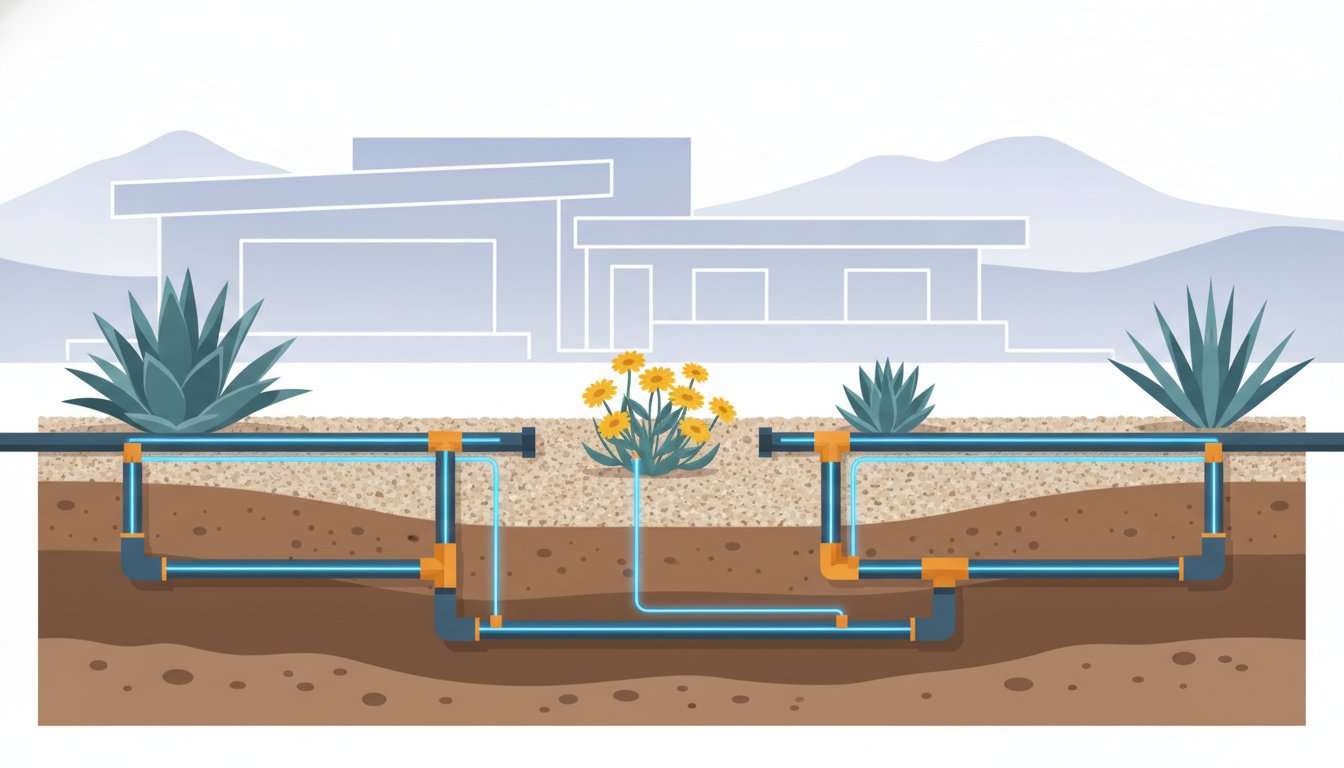
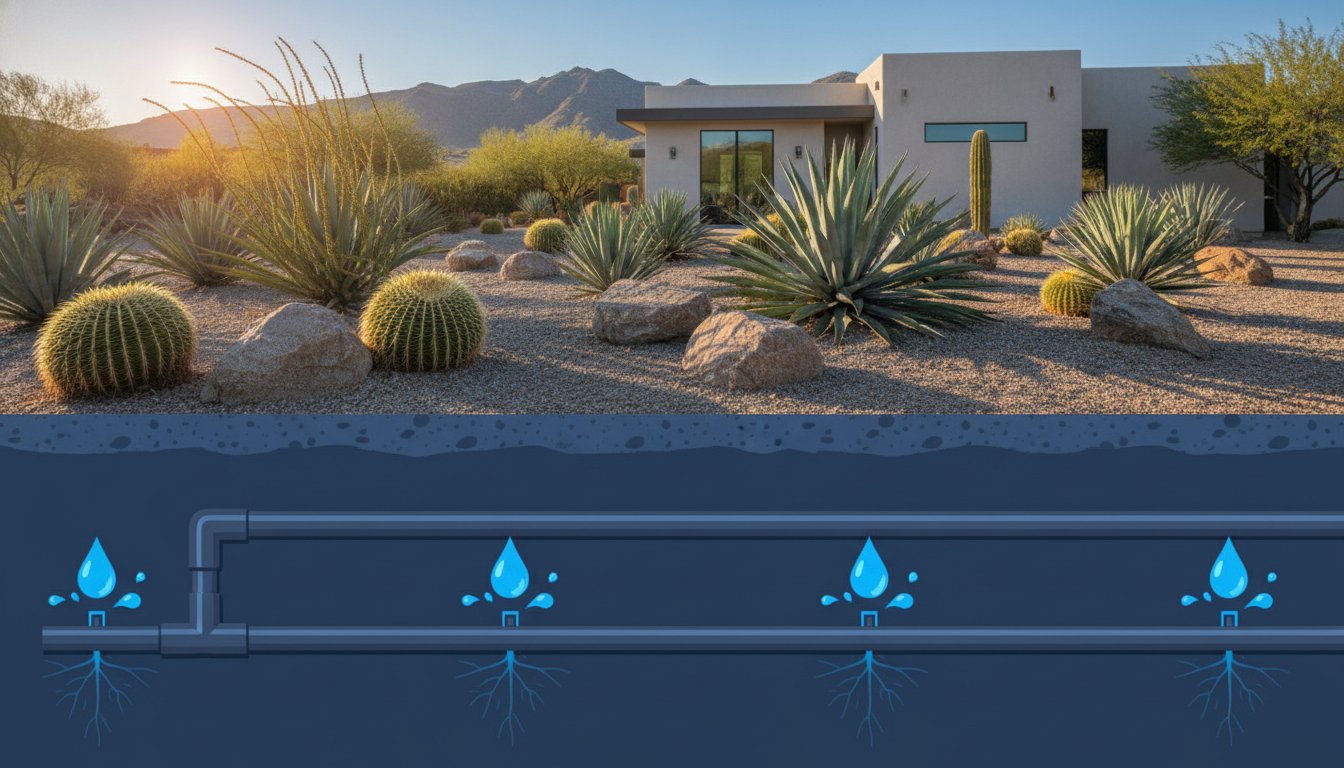
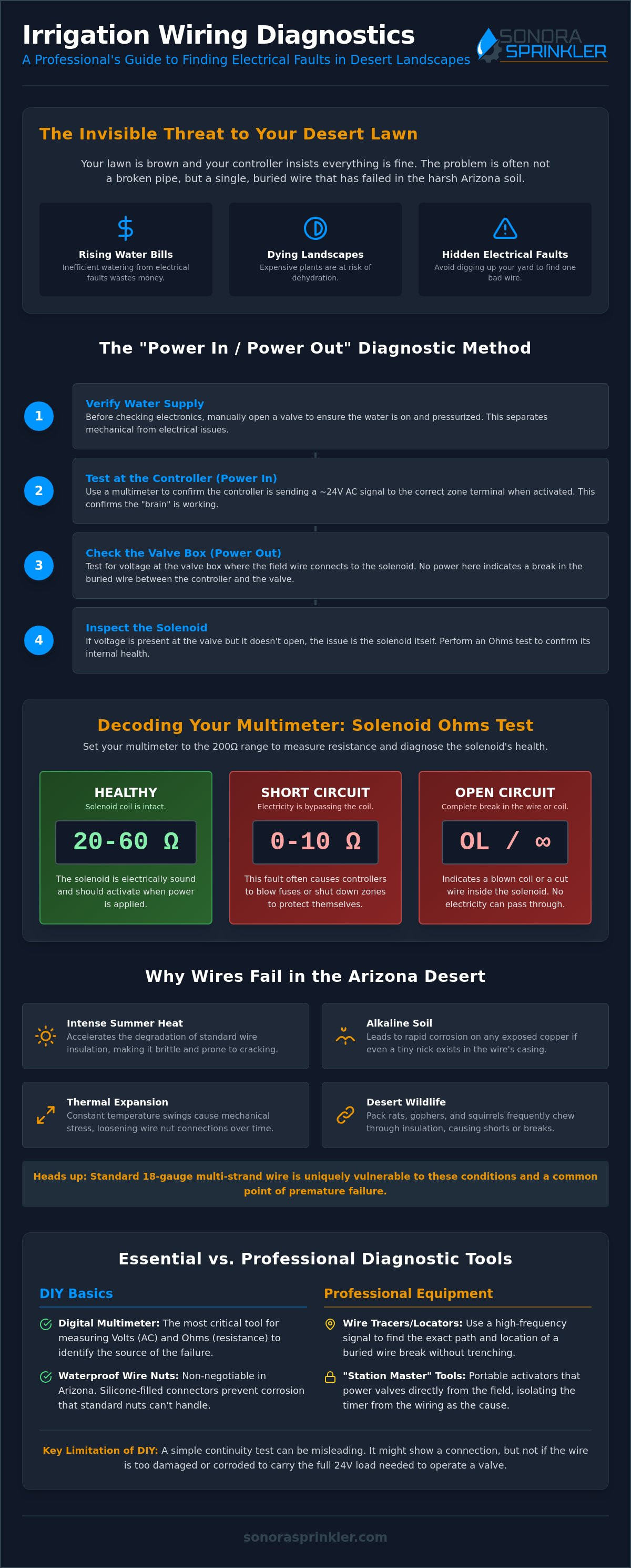
Irrigation wiring serves as the vital low-voltage communication link between your irrigation controller and the valve solenoids that regulate water flow. In the harsh environment of Surprise and Peoria, this wiring is under constant pressure. While standard 18-gauge multi-strand wire is common in many residential systems, it often proves uniquely vulnerable to Arizona's extreme conditions. The intense summer heat accelerates the degradation of wire insulation, while the alkaline nature of local soil can lead to rapid corrosion if even a small nick is present in the casing. Proper irrigation wiring diagnostics are essential for identifying these invisible points of failure before they lead to landscape loss.
Local property owners must also contend with the physical effects of thermal expansion and contraction. In Surprise, AZ, the temperature swing between a 115-degree afternoon and a cooler night causes materials to expand and contract repeatedly. This mechanical stress can loosen wire nuts or pull connections apart inside valve boxes. Additionally, desert wildlife such as pack rats and ground squirrels frequently target irrigation wiring in residential yards. These rodents often chew through the insulation, creating shorts or complete breaks that are difficult to locate without specialized equipment. Just as you protect your wiring from the elements, ensuring your cooling system is optimized for the climate is vital, and Ray Brown Air and Heat provides essential guidance on energy ratings and system efficiency to keep your home running smoothly.
Common Signs of Electrical Failure
Electrical failures often manifest in subtle ways before a zone completely dies. If you see a "No AC" or "Fuse" error message on your controller, the system has detected a surge or a short circuit. Sometimes, the timer shows a zone is running, yet the sprinklers remain silent. Another indicator is weak water flow. If a solenoid doesn't receive the full 24 volts required, it may only partially open the valve, leading to a drop in pressure that mimics a leak or a pump issue. Recognizing these symptoms early can prevent the total failure of your drip or sprinkler system.
Why 'Power In / Power Out' Logic Matters
Effective irrigation wiring diagnostics rely on a "power in, power out" logical progression. This method involves tracing the flow of electricity from the wall outlet, through the transformer, and out to the field wires. You must distinguish between a "dead" controller that has lost its internal transformer and a "broken" field wire that is failing to carry the signal to the valve. Before diving into electrical readings, manually open a valve to ensure the water supply is pressurized and available. Understanding this sequence allows you to isolate the problem area quickly. If the controller is sending power but the valve isn't responding, the issue is likely buried in the yard or located at the solenoid itself. For complex tracing, our team provides specialized irrigation wiring diagnostics to find these faults without unnecessary digging.
Essential Tools for Irrigation Wiring Diagnostics
To perform accurate irrigation wiring diagnostics , you must move beyond visual inspections and rely on precision instruments. A standard digital multimeter is the most important tool in your arsenal, allowing you to measure both electrical resistance (Ohms) and voltage (Volts). While a basic meter can identify a dead circuit, professional-grade equipment like wire tracers and locators are necessary to find buried breaks without trenching your entire lawn. We also utilize "Station Master" devices, which act as a temporary controller to activate valves directly from the field. This helps us isolate whether a failure is caused by the timer or the underground wiring. In our Arizona climate, even the best tools won't help if the repair isn't durable. This is why high-quality, waterproof wire nuts filled with silicone sealant are non-negotiable. Standard wire nuts will corrode within a single monsoon season, leading to the very common irrigation system failures that plague many residential properties.
Using a Multimeter for Ohms Testing
Testing for resistance is the most effective way to gauge the health of your valve solenoids. You should set your multimeter to the 200-ohm range to get an accurate reading. A healthy solenoid typically registers between 20 and 60 ohms. If your reading is significantly lower, such as 0 to 10 ohms, you have a short circuit where the electricity is bypassing the solenoid's coil. Conversely, an "infinite" or "OL" (Open Loop) reading indicates a complete break in the wire or a blown coil. These readings provide a clear roadmap for your repair, showing you exactly where the electrical path has been compromised.
Professional vs. DIY Diagnostic Equipment
Many homeowners attempt to use simple "continuity" testers, but these tools have significant limitations. A wire that is nicked or partially corroded may still show continuity, yet it won't have enough integrity to carry the 24-volt load required to open a valve. Professional irrigation wiring diagnostics utilize high-frequency locators that can trace the exact path of a buried wire and pinpoint the location of a "nick" or ground fault. This level of precision prevents "exploratory digging" that can damage your landscape or other utility lines. Learn more about our professional wiring and diagnostics services to see how we use these advanced tools to protect your property. If you find yourself struggling with inconsistent electrical readings, feel free to contact our team for a professional assessment.
Step-by-Step Troubleshooting for Common Wiring Issues
Effective irrigation wiring diagnostics require a systematic approach to isolate the failure point without disturbing your landscape. We recommend starting at the irrigation controller, which serves as the hub of the entire system. By testing the output terminals with a multimeter, you can confirm whether the "brain" is actually sending a 24-volt signal to the field. If the controller shows proper voltage at the station terminal but the valve fails to open, you have successfully ruled out a programming or transformer issue. This logical progression saves time and prevents the unnecessary replacement of a perfectly functional timer.
Once you confirm the controller is active, the next step is to move to the valve box. This is where environmental stressors often take their toll. You should inspect both the "hot" wire for the specific zone and the "common" wire, which is typically the white wire that completes the electrical circuit for every valve in the system. A single loose connection on the common wire is the most frequent cause of multiple zones failing simultaneously. Look for green copper corrosion or brittle insulation, which are clear indicators that the desert heat has compromised the electrical path. If the connections appear solid, the focus must shift to the solenoid itself.
Testing for a Bad Solenoid
To accurately test a solenoid, you must disconnect it from the field wires to ensure you are getting a clean resistance reading. Using the multimeter settings discussed previously, check for a reading between 20 and 60 ohms. A "shorted" solenoid will show very low resistance, often causing the controller's fuse to blow or the display to go dark. An "open" circuit reading indicates the internal wire coil has snapped, meaning the component can no longer create the magnetic field necessary to lift the valve plunger. For a deeper look at this process, see our guide on how to test if you have a bad valve for your sprinkler system.
Identifying Underground Wire Breaks
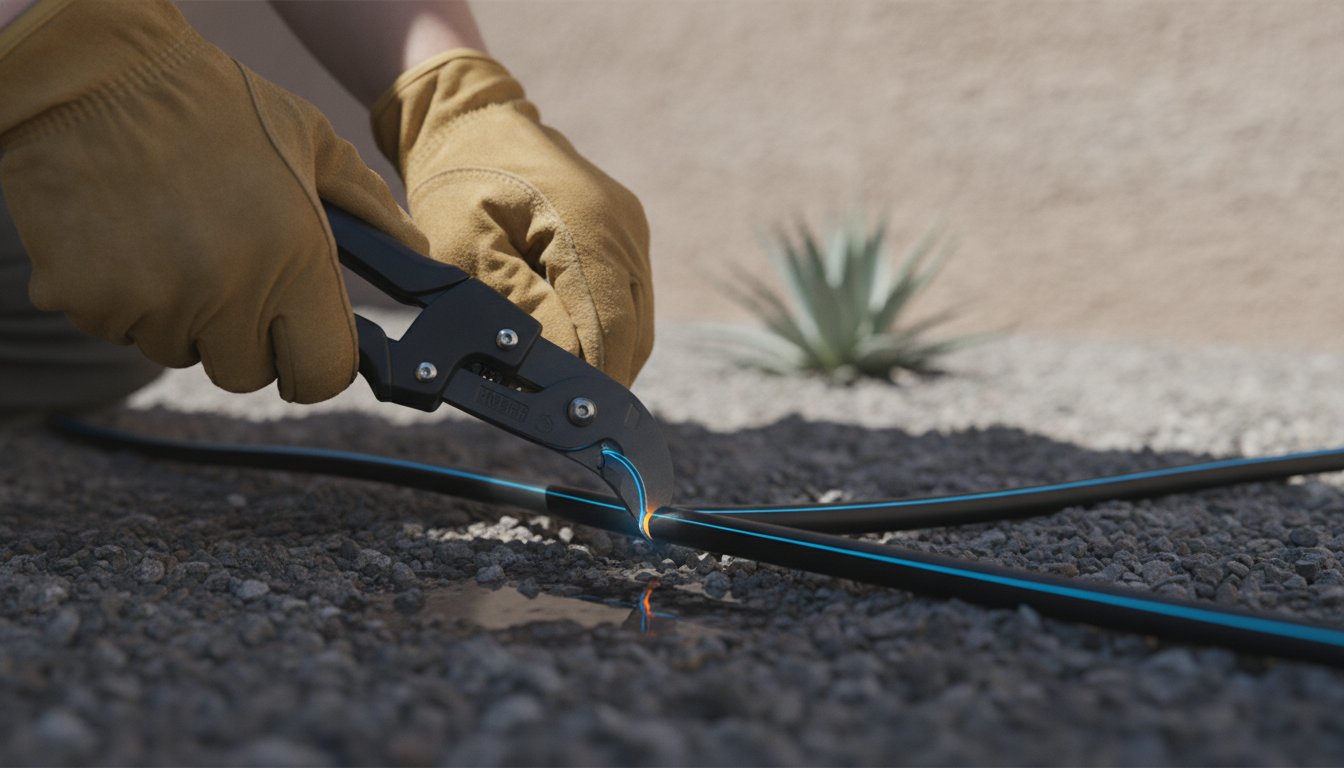
If both the controller and the solenoid test positive for health, the break is likely hidden underground. In Arizona yards, these breaks frequently occur near shovel-depth edges where edging was installed or near growing tree roots that have pinched the line. During irrigation wiring diagnostics , we sometimes find "ghost signals." This happens when a meter shows voltage at the valve, but the wire is so degraded that it cannot carry enough current to actually move the solenoid. If you are using a multi-strand wire bundle, you might find a "spare" wire that isn't currently in use. Swapping the failed line for this spare can be a quick, non-invasive fix that avoids trenching your yard. However, if multiple wires are damaged, professional tracing equipment is required to find the exact point of the fault. While we focus on irrigation in Arizona, maintaining your home's climate systems is universally important; you can learn more about Air Services Mechanical to see how professional HVAC diagnostics protect your property's comfort and efficiency.
Comparing Diagnostic Results: Short vs. Open Circuits
Once you have gathered your electrical readings, the final phase of irrigation wiring diagnostics involves interpreting whether you are facing a short circuit or an open circuit. These two failures represent opposite ends of the electrical spectrum, yet both will prevent your sprinklers from activating. A short circuit occurs when electricity finds a path of less resistance to the ground before it reaches the solenoid. In our Surprise and Peoria landscapes, the highly alkaline soil acts as an effective conductor when it comes into contact with exposed copper. If wire insulation has been compromised by heat or wildlife, electricity "leaks" into the earth. This sudden surge of current often causes the controller's internal fuse to blow or the circuit breaker to trip as a protective measure.
Partial shorts are particularly deceptive. In these cases, the wire might be nicked but not fully grounded, leading to erratic system behavior. You might notice your controller humming loudly or resetting unexpectedly every time a specific zone tries to start. This happens because the system is struggling to maintain the correct current flow against the resistance of the damaged wire. Identifying these issues early is vital to prevent permanent damage to the "brain" of your irrigation system; similarly, you should explore HVAC Installation, Repair, and Maintenance to ensure your home's cooling system doesn't suffer from similar electrical stressors.
Symptoms of a Short Circuit
- Repeated Fuse Failures: If you replace a fuse and it blows the moment a specific zone activates, you have a direct short to ground.
- Physical Damage: Look for burn marks or melted plastic on the solenoid casing or the controller's terminal strip.
- Intermittent Operation: A nicked wire in soil that is currently wet from a monsoon storm can create a temporary short that disappears once the ground dries out.
Symptoms of an Open Circuit
An open circuit is a complete break in the electrical loop. While the controller might display that the station is active, the electricity simply has no path to reach the valve. This is almost always characterized by a high resistance reading on your multimeter, typically exceeding 60 ohms or showing an "infinite" result. The common wire remains the Achilles heel of the entire system. Because this single wire serves every valve, a break at the beginning of the line will disable every zone simultaneously. This leaves your entire desert landscape vulnerable to the heat, even if every individual solenoid is in perfect working order.
If your diagnostics reveal a complex short or a break buried deep beneath your hardscape, don't risk further damage to your controller. You can schedule a professional diagnostic visit to have our technicians trace and repair the fault with precision equipment.
When to Call a Professional for Irrigation Wiring Repair
While DIY troubleshooting can resolve simple solenoid issues, some electrical faults are deeply hidden. We often suggest the "Three-Hour Rule" for homeowners in Surprise and Peoria. If you haven't identified the specific location of a break after three hours of testing, you are likely dealing with a complex fault that requires industrial-grade tracing equipment. Professional irrigation wiring diagnostics utilize high-frequency locators that find the exact path of a wire, even when it is buried beneath several inches of compacted desert soil or trapped behind mature tree roots. Continuing to dig blindly risks damaging your PVC mainlines or other utility connections.
There is significant long-term value in professional irrigation repairs and maintenance for Surprise homeowners. A specialist doesn't just patch a wire; they ensure the entire circuit is balanced and protected against the regional environmental stressors we discussed earlier. When multiple zones fail and a basic common wire check at the valve box doesn't solve the problem, the fault is often located in a splice buried somewhere under a driveway or patio. These scenarios require a level of precision that standard multimeters simply cannot provide.
The Sonora Sprinkler Inc. Diagnostic Advantage
Our team brings a "boots-on-the-ground" expertise to every residential property. We use precision equipment to locate a wire break within the exact inch, minimizing the impact on your yard. This is especially helpful for drip system troubleshooting where wires are often buried shallowly and are more prone to accidental damage from gardening tools. As a family-owned business serving the community since 1999, Sonora Sprinkler Inc. understands that a functional irrigation system is the only thing standing between a thriving landscape and the harsh Arizona sun. To further enhance your home's efficiency and electrical performance, you can discover Underline Energy Concepts and their specialized energy-saving solutions.
While maintaining your irrigation is crucial for plant health, you can also elevate your landscape's aesthetic with professional low-voltage lighting; check out LED Artistry to discover how custom architectural lighting can showcase your property after dark.
Preventing Future Wiring Failures
Longevity starts with the right materials. During new sprinkler system installations, we prioritize the use of direct-burial rated wire that features a thicker, more durable jacket. In areas of your yard where pack rats are active or where foot traffic is heavy, we recommend installing wiring inside PVC conduit for an extra layer of protection. Scheduling an annual check for your irrigation wiring diagnostics can help catch minor corrosion at the connectors before it leads to a total system failure. This proactive approach ensures your landscape remains healthy while avoiding the stress of emergency repairs in the middle of a summer heatwave.
Protecting Your Desert Landscape from Invisible Electrical Faults
Navigating the complexities of your sprinkler system doesn't have to be a guessing game. By applying a logical approach to irrigation wiring diagnostics , you can pinpoint whether a failure is a simple solenoid replacement or a buried break hidden under your hardscape. It is vital to remember that Arizona's environment is uniquely demanding; the combination of intense heat and alkaline soil requires durable solutions rather than temporary patches. Whether you are swapping a failed line for a spare wire or upgrading to waterproof connectors, your focus should always remain on the long-term health and efficiency of your residential property; for those seeking professional assistance with their home's internal climate systems, you can visit E.R.S. Heating & Cooling for expert HVAC and refrigeration services.
Since 1999, Sonora Sprinkler Inc. has operated as a family-owned specialist dedicated to the specific needs of Surprise and Peoria homeowners. We utilize advanced wire-tracing technology to locate hidden faults with precision, ensuring your yard remains undisturbed during the repair process. If your troubleshooting has reached a standstill, it is better to seek a professional remedy than to risk further damage to your controller or your landscape. Schedule your professional irrigation wiring diagnostic in Surprise or Peoria today to restore your system's reliability. With the right expertise, you can keep your desert landscape green and thriving through even the most intense summer heat.
Frequently Asked Questions
How do I know if my irrigation controller is bad or if it's the wiring?
You can determine the source of the failure by testing the output terminals with a multimeter while the station is active. If the meter shows between 24 and 28 volts at the controller but the valve fails to open, the issue lies in the field wiring or the solenoid. If there is no voltage output at the terminal, the controller's internal transformer or station module has likely failed.
What should the ohm reading be on a good sprinkler solenoid?
A functional solenoid typically registers between 20 and 60 ohms of resistance. This specific range indicates that the internal wire coil is intact and capable of creating the magnetic field needed to lift the valve plunger. Readings that fall outside this range, such as a very low 0 to 10 ohms or an infinite "OL" reading, signify a short circuit or a broken internal wire.
Can a rodent chewing on a wire cause my whole system to stop working?
Yes, if a rodent chews through the common wire, every zone in your system will fail to activate at the same time. Pack rats and ground squirrels in Surprise often target these wires for their insulation. Because the common wire provides the return path for the electrical circuit, a single break in this shared line prevents any valve from receiving power, regardless of the individual zone's health.
Why does my sprinkler fuse keep blowing every time a specific zone starts?
This behavior usually indicates a direct short circuit to the ground within that specific zone. When a wire's insulation is compromised and the copper makes contact with wet or alkaline soil, the electricity finds a shortcut. This creates a sudden surge in current that exceeds the fuse's capacity, causing it to blow instantly to protect the controller's delicate internal circuitry from permanent electrical damage.
Is it possible to find a buried wire break without digging up my whole yard?
Professional technicians use specialized high-frequency wire locators to pinpoint breaks within a few inches of the fault during irrigation wiring diagnostics . These tools send a distinct signal through the wire that can be traced from the surface. This diagnostic approach allows us to perform precise repairs and localized digging, which protects your established desert landscape from the unnecessary damage of exploratory trenching.
What is a 'common wire' and why is it so important for irrigation diagnostics?
The common wire is the single electrical return path that connects every valve in your system back to the controller. It is the most critical component in irrigation wiring diagnostics because a fault here has a universal impact on system operation. Identifying a common wire break is the fastest way to explain why multiple zones have stopped responding simultaneously, even if the controller appears to be functioning.
Can I use regular wire nuts for irrigation wiring repairs in Arizona?
You should never use standard dry-location wire nuts for underground irrigation repairs. Arizona's soil and seasonal monsoon moisture will cause standard nuts to corrode within months. Instead, you must use waterproof, grease-filled connectors that seal out oxygen and moisture. These specialized connectors ensure a durable connection that can withstand the mechanical stress of thermal expansion and the corrosive nature of the local soil.
How much does professional irrigation wiring diagnostics cost in Surprise, AZ?
The cost of professional diagnostics typically depends on the complexity of the electrical fault and the time required to trace buried lines. This service fee covers the use of specialized equipment and the expertise needed to isolate issues without damaging your property. Investing in professional diagnostics often saves money by preventing the unnecessary replacement of functional parts and avoiding the high costs of extensive landscape restoration.